From Global Commitments to Classroom Reality: How the UN’s Digital Compact is Taking Shape in Costa Rica
Written by Carolina Azevedo, Chief, Communications & Results Reporting, UN Development Coordination Office (DCO); and Danilo Mora, Communications Officer, UN Costa Rica
When Member States adopted the Pact for the Future and the Global Digital Compact in 2024, they committed to harnessing digital technologies, including artificial intelligence, in ways that are ethical, inclusive and grounded in human rights.
The commitments are clear: close digital divides, govern risks, protect rights and ensure that emerging technologies accelerate progress toward the Sustainable Development Goals.
But global commitments do not implement themselves.
The real test of the Global Digital Compact lies not in conference halls but in classrooms, public institutions and national policy frameworks.
This is where the Resident Coordinator system becomes critical.
Costa Rica offers a powerful example of how global digital governance principles can be translated into national capacity and tangible results.
Costa Rica: Turning AI governance into practice
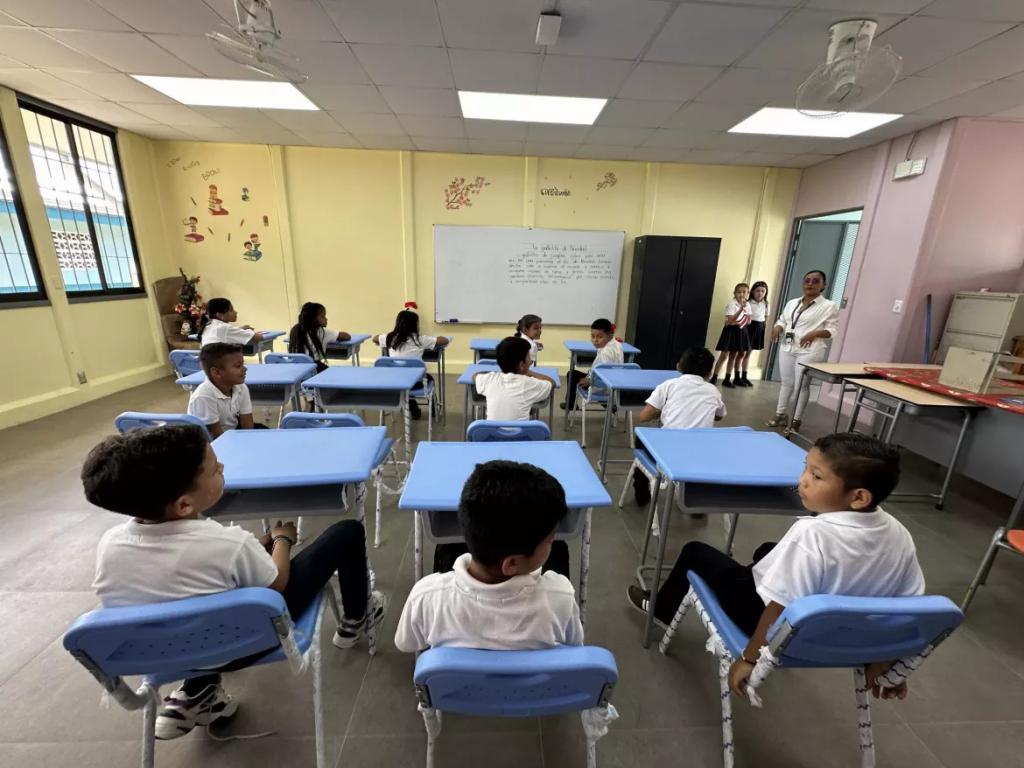
Earlier this year, the United Nations in Costa Rica launched the country’s first National Guide on Artificial Intelligence for Educators. The initiative supports more than 65,000 teachers and nearly one million students as they begin the 2026 academic year with access to AI tools designed to enhance learning, safely and responsibly.
The guide is important. But the deeper achievement lies in the architecture behind it.
Developed in partnership with the Ministry of Public Education, the UN Educational, Scientific and Cultural Organization (UNESCO) and the Latin American University of Science and Technology, the initiative translates global AI governance principles into practical classroom guidance. It embeds safeguards on privacy, bias mitigation and responsible use, ensuring that AI strengthens educational equity rather than deepening divides.
This was not a standalone product. It was the result of coordinated action.
Under the leadership of the Resident Coordinator’s Office, the UN Country Team aligned global standards with national priorities, convened government, academia and innovation partners to a common consensus and ensured coherence across agencies.
The outcome demonstrates how digital governance can move from abstract principle to operational policy.
The Resident Coordinator system: the missing connector
In today’s AI landscape, fragmentation is the greatest risk. Digital pilots multiply. Standards diverge. Public trust becomes fragile.
The comparative advantage of the Resident Coordinator system is not technical ownership of AI tools. It is institutional alignment.
The system acts as a connector ensuring that global norms, national policy and innovation ecosystems reinforce rather than contradict one another.
In practice, this connector role operates across four strategic functions:
Convening for coherence
Bringing together government institutions, UN entities, academia, civil society and private sector partners around a shared digital agenda.
Translating global norms
Grounding international standards, from human rights to algorithmic accountability, in national frameworks and pilots.
Strengthening evidence and accountability
Supporting data-driven decision-making and measurable development outcomes.
Enabling scale
Moving from isolated initiatives to sustainable, financeable and replicable models that leave no one behind.
In Costa Rica, this approach transformed digital experimentation into a coherent national effort aligned with global commitments under the Global Digital Compact.
UN 2.0: Strengthening capability for a digital era
The Secretary-General’s UN 2.0 vision reinforces these efforts by strengthening the UN’s internal capabilities through its “quintet of change”: data, digital, innovation, strategic foresight and behavioural science.
AI governance demands precisely these capacities.
Countries navigating digital transformation require support that integrates technical knowledge, risk awareness, behavioural insights and long-term strategic thinking.
Costa Rica’s experience illustrates how these capabilities can be activated at country level, combining innovation with safeguards, and digital ambition with public trust.
Modernization in this context is not about digitizing existing systems. It is about redesigning them to manage technological change responsibly and inclusively.

From national example to scalable model
The lessons emerging from Costa Rica are relevant far beyond its borders.
Through the Resident Coordinator system, countries seeking to operationalize the Global Digital Compact are supported with:
- Diagnostics of digital capacity and governance gaps
- Multi-stakeholder coordination platforms
- Prioritized portfolios of high-impact AI use cases
- Safe and evaluable pilot environments
- Pathways to blended financing and sustainable scale
- Strengthened information integrity and public trust
This model moves digital governance from aspiration to institutional capacity.
Scaling what works
The Global Digital Compact defines the direction: an inclusive, safe and sustainable digital future.
UN 2.0 strengthens the UN’s capabilities.
The Resident Coordinator system connects the two, ensuring that global ambition becomes national action.
Costa Rica demonstrates what is possible when global principles are aligned with country leadership, technical expertise and coordinated support.
The challenge now is not whether this model works.
It is how quickly and responsibly it can be scaled, country by country.
Please visit the UN team's website for more information about the UN's work in Costa Rica.





Latest news and updates