'Dedicated, Independent and Impartial Development Coordination Delivers' - UN Deputy Secretary-General at the 2026 ECOSOC OAS
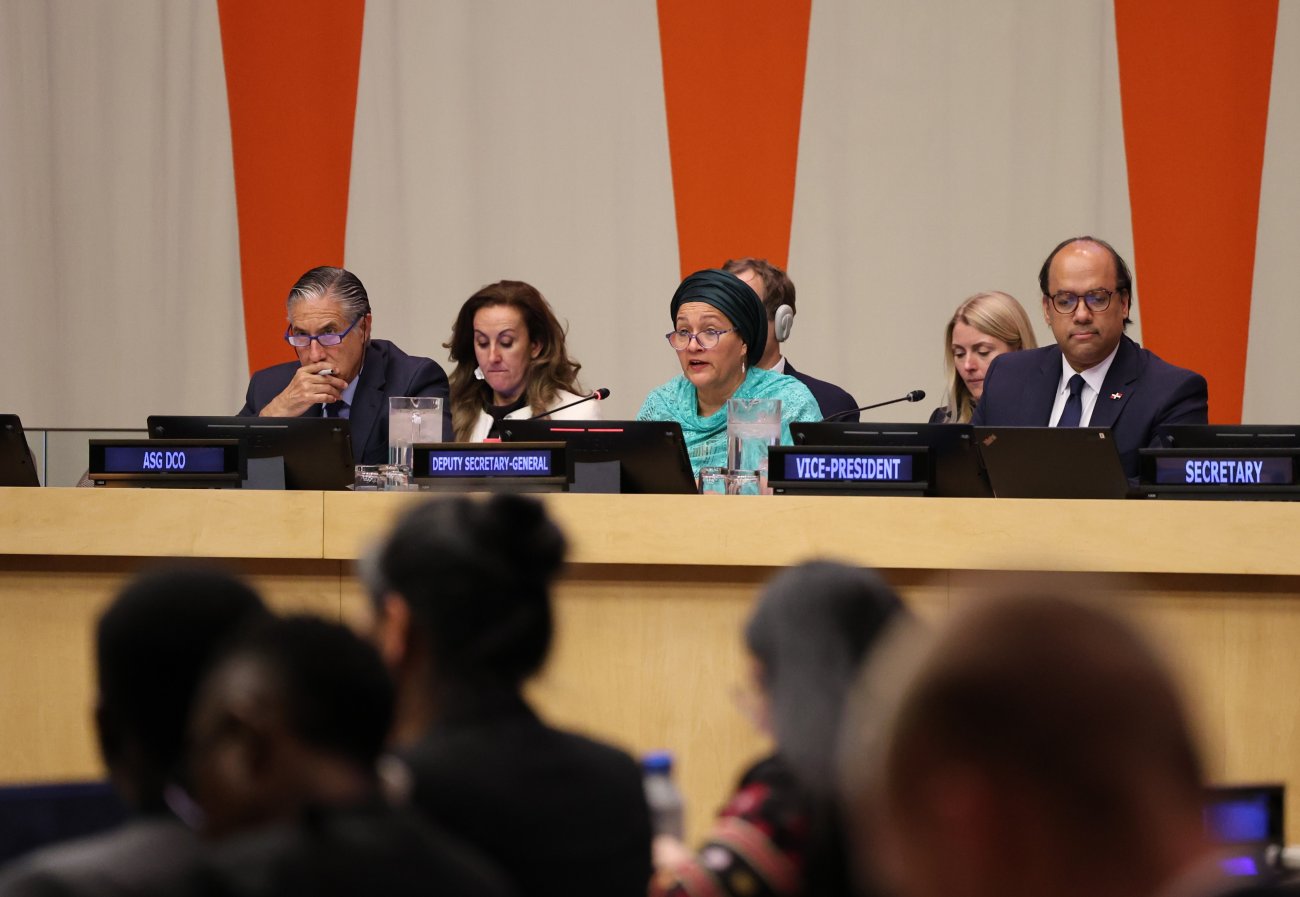
Following are UN Deputy Secretary-General Amina J. Mohammed's remarks to the opening of the Economic and Social Council’s Operational Activities for Development Segment for 2026, in New York:
Your Excellency, Vice-President of ECOSOC,
Excellencies,
We meet at a moment of extraordinary pressure and rising expectations for sustainable development and our UN system.
Countries are grappling with escalating crises, rising debt burdens and widening inequalities across regions, even as the urgency to deliver on the 2030 Agenda intensifies.
Just as demands are escalating, sharp declines in official development assistance are forcing difficult decisions on UN operational presence and capacity across the globe.
In many countries, entities are scaling back their presence, which makes access to the UN’s specialized capacities all the more important.
It is precisely in such a moment that coordinated support matters most. It is what ensures Member States continue to have access to the UN’s expertise whether or not the entity sits in their country.
Eight years ago, Member States tasked the Resident Coordinators with leading this effort. And the Secretary-General reiterated the progress in this regard earlier today.
The evidence in the reports leaves little room for doubt: dedicated, independent, and impartial development coordination delivers.
Under the leadership of Resident Coordinators, the UN development system scaled up its support to meet ever-higher expectations, and grew more effective at it.
93 per cent of host governments affirmed that Resident Coordinators provided strengthened leadership, an increase of nearly 30 percentage points since the reforms in 2019.
Recognition of Resident Coordinators as the entry point to the entire UN system rose from 62 per cent to 90 per cent over the same period.
We have continued to empower Resident Coordinators to strengthen their leadership. We have increased the representation of Resident Coordinators from programme countries – now 59%. And 55% of Resident Coordinators are women.
These results are down to your leadership, the guidance given to the system through successive resolutions since 2019, and your robust engagement with the system at every level.
Let me turn to the road ahead. Through UN80, there is a clear imperative to keep strengthening the Resident Coordinator system. The Secretary-General and I heard resounding support for this last week at the meeting hosted by the PGA.
The success of many of the UN80 packages will rest with the Resident Coordinators and their teams putting these changes into practice in country: from shaping UN country teams in close coordination with national governments, to bringing in non-resident capacities through expertise on demand mechanisms.
Resident coordinators will have a vital role in delivering on the ambition of UN80, and helping the system deliver these changes in over 160 countries.
They stand ready to work with the system to leverage the opportunities presented to better connect to the regional architecture through the regional reset, harness the work of the data commons, and bring in thematic knowledge and analysis through the Joint Knowledge Hubs.
Excellencies,
We must also be attuned to the challenges before us and the imperative to address them.
Let me start by highlighting four ways the RC system has supported more effective system-wide responses to needs in countries.
First, Resident Coordinators drew on the system’s policy expertise to drive shifts to advance national development priorities and the SDGs.
Resident coordinators worked with UN country teams across diverse country contexts from LDCs, LLDC, MICs to SIDS, and more.
And across all developing countries, UN country teams, under the leadership of Resident Coordinators, continued to support the SDG acceleration through integrated policy advice.
Second, Resident Coordinators brokered partnerships to scale up development support and unlock catalytic financing.
They worked with country teams and partners to open the door to public and private investment, and continued to bring together diverse sets of stakeholders to advance national SDG efforts.
They unlocked resources of the Joint SDG Fund and other pooled funds to deliver more coherent programming.
This past year, the Fund supported the expansion of social assistance to more than a million people in Uzbekistan, delivered over a million health treatments for adolescent girls in Kenya, and launched Jordan’s first national food-security information system.
Third, Resident Coordinators bridged development, humanitarian and peacebuilding action in countries beset by compounding crisis, risking their development trajectory.
Across the world, 28 Resident Coordinators also serve as humanitarian coordinators or Deputy Special Representatives of the Secretary-General in mission settings.
When disaster struck - Hurricane Melissa in Jamaica, wildfires in Chile - Resident Coordinators led the first response while humanitarian assistance was being scaled up.
In Cameroon, the Resident Coordinator’s convening role produced a single support framework coordinating humanitarian, development and stabilization efforts.
And where missions closed - in Iraq, Mali, and Sudan - Resident Coordinators have taken the lead guiding UN country teams with fewer resources at a critical juncture.
The RCs are reinforced by DCO’s surge capacity, which has been critical.
Based in the regions, this surge capacity lets DCO give rapid support to countries when the context changes, bringing in the skills needed.
Fourth, Resident Coordinators helped the UN development system deliver efficiencies and greater transparency for Member States.
In 2025, the share of UN buildings operating as common premises in countries rose to 33 per cent, accommodating 57 per cent of UN personnel.
Part of these efforts contributed to the $981.1 million in efficiency gains in 2025, more than three times the target set at the outset of reform, and the highest total ever reported.
While this figure is striking, and has been triple checked, our journey does not end there. Resident Coordinators will be at the forefront of efforts to keep bringing UN entities together in country behind the system wide efficiency initiatives.
Last but not least, transparency on the work of the RC system and UN country teams was unprecedented.
Digital platforms and annual reporting by UN country teams now provide a clear window in progress advancing Cooperation Frameworks in countries.
Importantly, all Member States today have visibility and can guide the work of the RC system with unparalleled oversight through ECOSOC and the General Assembly.
Excellencies,
The Resident Coordinator system has undoubtedly delivered on the guidance you have given for their leadership in country. However, the demands placed on it, the evolving global context and the stark diagnosis of what is needed to deliver on the 2030 Agenda necessitated a review of the system.
The recalibration is meant to strengthen the capacity and effectiveness of the system, and to sharpen its ability to respond to the mandates you – Member States - have set.
Your feedback and insights are shaping its design, and we will keep engaging with you as it advances.
We envision change across three reinforcing levels.
At country level, RCO profiles of core functions will be tailored to specific country needs; and the share of national staff raised.
The aim is to bring in the right capacities for the specific country context. Reflecting on the specific needs of LDCs, LLDCs, SIDS, and complex settings, more specific capacities will be brought in to match – for example a specialist in World Bank collaboration, or convening for SDG Financing.
At the regional level, DCO teams will be reconfigured to deliver faster and more targeted support to RCOs, support to subregional priorities, and enable better policy coherence, particularly for SDG financing.
At headquarters, DCO will streamline its leadership structure, consolidate data and digital capacities, step up support for efficiency efforts across the UN development system, and strengthen accountability to Member States.
Across all three levels, the focus will be on embracing innovation and stepping up efforts to make better use of data, digital solutions, and foresight to inform decision-making.
This is about delivering an RC system that can support countries as they respond to not only today’s challenges but future ones.
Excellencies,
A word, now, on what is making this harder. The system has never been fully resourced to $281m, and has had to keep implementing cost mitigation measures to reduce the impact of the shortfalls.
The system remains largely dependent on voluntary contributions, which in 2025 fell to their lowest level since the system was established.
The 1% levy on earmarked resources has structural flaws, low compliance rates, high administrative costs, and an over-reliance on aid flows. The variability of these two streams continues to hamper the ability of the system to plan and deploy resources. Only 64% of RC offices were fully staffed in 2025.
Despite funding cuts, UNSDG entities paid their shares of the cost sharing arrangement.
The 53 million dollars from the regular budget granted in 2024 and renewed in 2025 provides an essential backstop for the system.
But it did not close the funding gap.
In 2025, the system faced a shortfall of $46 million US dollars.
Funding reached just $236 million against a requirement of $281 million.
The comprehensive review of the funding model, which the General Assembly takes up in the fall at its eighty-first session, is the moment to act and strengthen the RC system.
Initial analysis was already presented to you in the Secretary-General’s QCPR report, and will be detailed further in his forthcoming report to the General Assembly.
The RC system is the most cost-effective investment we have for delivering sustainable development at scale, at roughly 1.3 per cent of total UN operational expenditure – a very modest cost for system-wide coherence and impact.
Excellencies,
We have entered the final stretch of the 2030 Agenda, and simply cannot afford to lose ground.
The UN80 Initiative offers fresh momentum to consolidate the system’s support to countries and turn the page on the unfinished business of the 2018 reforms.
The question before us is no longer whether coordination works.
The question is whether we will equip our coordination system to deliver with the scale and urgency you need.
Thank you.
Read the 2026 UNSDG Chair Report on the Development Coordination and Resident Coordinator System: Report | Online Interactive Version
This statement was delivered at the 2026 ECOSOC OAS.





Latest news and updates