From National Progress to Global Solutions: Viet Nam and the UN Open a New Chapter
New five-year country programmes, a renewed commitment to the Green One UN House and plans for a regional counter-cybercrime hub signal an increasingly strategic partnership designed to accelerate Viet Nam’s national ambitions while sharing its experience beyond its borders.
Nearly five decades after joining the United Nations, Viet Nam is entering a new phase in its development journey, and reshaping its partnership with the UN along the way.
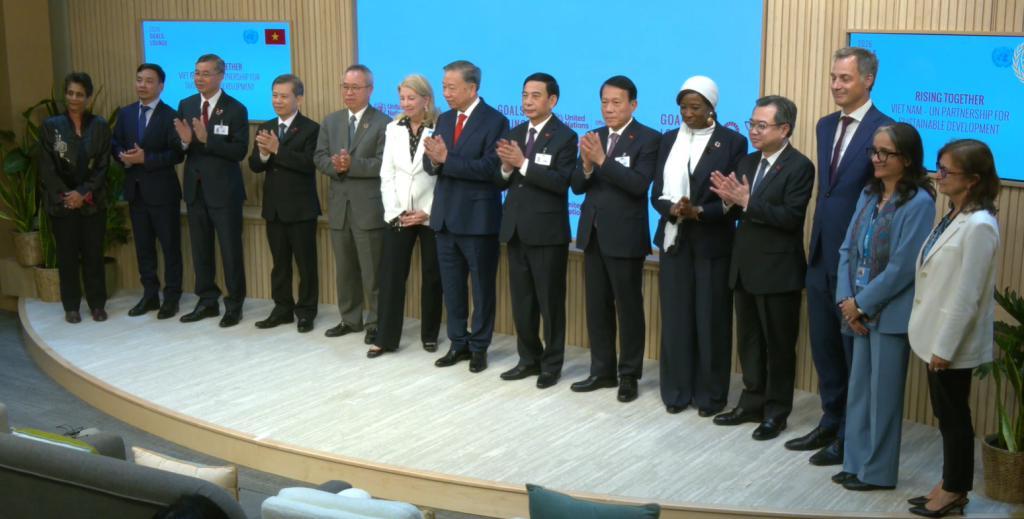
At the special event Rising Together: Viet Nam–UN Partnership for Sustainable Development, held during the UN General Assembly High-level Week, Viet Nam and UN leaders set out a shared vision for the years ahead: one focused on green and digital transformation, investment in people, resilience to demographic and climate change, and solutions that can travel beyond national borders.
Hosted by H.E. Tô Lâm, General Secretary of the Central Committee of the Communist Party of Viet Nam and President of the Socialist Republic of Viet Nam, the event marked the formal handover of the 2027–2031 Country Programme Documents of the United Nations Development Programme (UNDP), United Nations Population Fund (UNFPA) and United Nations Children’s Fund (UNICEF).
Together, the programmes translate the priorities of the new United Nations Sustainable Development Cooperation Framework into concrete action. They are aligned with Viet Nam’s ambitions to become a high-income developed country by 2045 and achieve net-zero emissions by 2050, while addressing persistent inequalities, technological disruption, climate risks and rapid population ageing.
“Viet Nam’s development journey has transformed its relationship with the United Nations,” said UN Resident Coordinator in Viet Nam Pauline Tamesis. The new programmes, she noted, reflect a more strategic and two-way partnership — one through which Viet Nam can increasingly share its experience, leadership and solutions with other countries.
Investing in transformation — and in people
UNDP’s new programme will support four interconnected priorities: climate action and environmental sustainability; economic and digital transformation; inclusive human development; and governance and the rule of law.
Speaking at the event, UNDP Administrator Alexander De Croo said the next chapter should do more than accompany Viet Nam’s development: it should help create a “playbook for development” that can benefit the wider world.
For UNICEF, the programme places children and young people at the centre of Viet Nam’s future. It will support more equitable access to healthcare, nutrition, education and social protection; strengthen protection from violence and exploitation, including online; and help communities and essential services withstand mounting climate and environmental risks.
“Investing in children is one of the most powerful investments a country can make in its future,” UNICEF Executive Director Catherine Russell told participants.
UNFPA’s programme responds to a profound demographic transition: within the next decade, one in five people in Viet Nam is expected to be over 60. Its work will help the country use population data and evidence to prepare for an ageing society, protect sexual and reproductive health and rights, strengthen responses to gender-based violence and ensure that progress reaches people in the most remote communities.
UNFPA Executive Director Diene Keita pointed to one recent example of what sustained partnership can deliver: zero maternal deaths recorded through a UNFPA-supported initiative serving 60 remote villages.
A partnership built to deliver as one
The event also highlighted the infrastructure and institutions underpinning a more integrated UN presence in the country.
Viet Nam extended its rent-free provision of the Green One UN House in Ha Noi for a total of 20 years. Home to multiple UN entities, the building is a practical expression of a UN development system working together, reducing fragmentation while enabling more joined-up support to national priorities.
A further letter of intention between Viet Nam’s Ministry of Public Security and the United Nations Office on Drugs and Crime (UNODC) advanced cooperation around the Regional Counter Cybercrime Hub for Asia-Pacific in Ha Noi.
The hub is expected to support information sharing, research and early warning on emerging cybercrime; strengthen capacity in digital forensics, data science and artificial intelligence; and connect governments, international organizations, technology companies and researchers across the region.
From partnership to shared leadership
Viet Nam joined the United Nations in 1977 and will mark 50 years of membership in 2027. Over those decades, the partnership has contributed to far-reaching gains in poverty reduction, health, education, gender equality, child rights, governance and environmental sustainability.
But the story emerging from New York was not only one of past achievement. It was about what comes next.
As Viet Nam’s capabilities and global influence grow, its relationship with the UN is evolving from traditional development assistance towards policy expertise, innovation, financing, knowledge exchange and South-South and triangular cooperation.
That evolution carries a wider lesson for the UN development system: when national leadership, coordinated UN support and long-term investment come together, country-level progress can become a source of solutions for the world.
Viet Nam and the UN are not simply renewing a partnership. They are redefining what that partnership can deliver at home, across the Asia-Pacific region and beyond.
Please visit the UN team's website for more information about the UN's work in Viet Nam.





Latest news and updates